How it works
The mechanism, in order.
Nothing here folds out of a roof box. The system extends outward first to make room, then builds a structure, then skins it.
Drawn from the engineering sequence, not from the marketing renders. Production target 35–60 seconds; first prototype is allowed 90.
Sequence
Twelve steps, two of which are checks.
Vehicle confirms Park and zero wheel speed.
Ultrasonic and time-of-flight scan for people, animals and obstacles.
Left and right cassettes translate outward 150–250 mm.
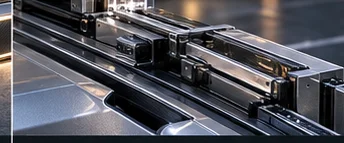
Front and rear receiver rails extend.
Four primary arches telescope upward.
Two secondary arches deploy between them.
Arches synchronise and lock into the upper spine nodes.
Clear segmented panels extend from the side and rear cassettes.
Panel edges engage the adjacent arches.
Lower edges drop into the perimeter seal rail.
Electronic locks engage at every node.
Climate ventilation starts and the security layer arms.
Retraction is the same list, reversed, with a de-ice check inserted before the panels move if the enclosure has been below freezing.
Architecture
Eight subsystems.
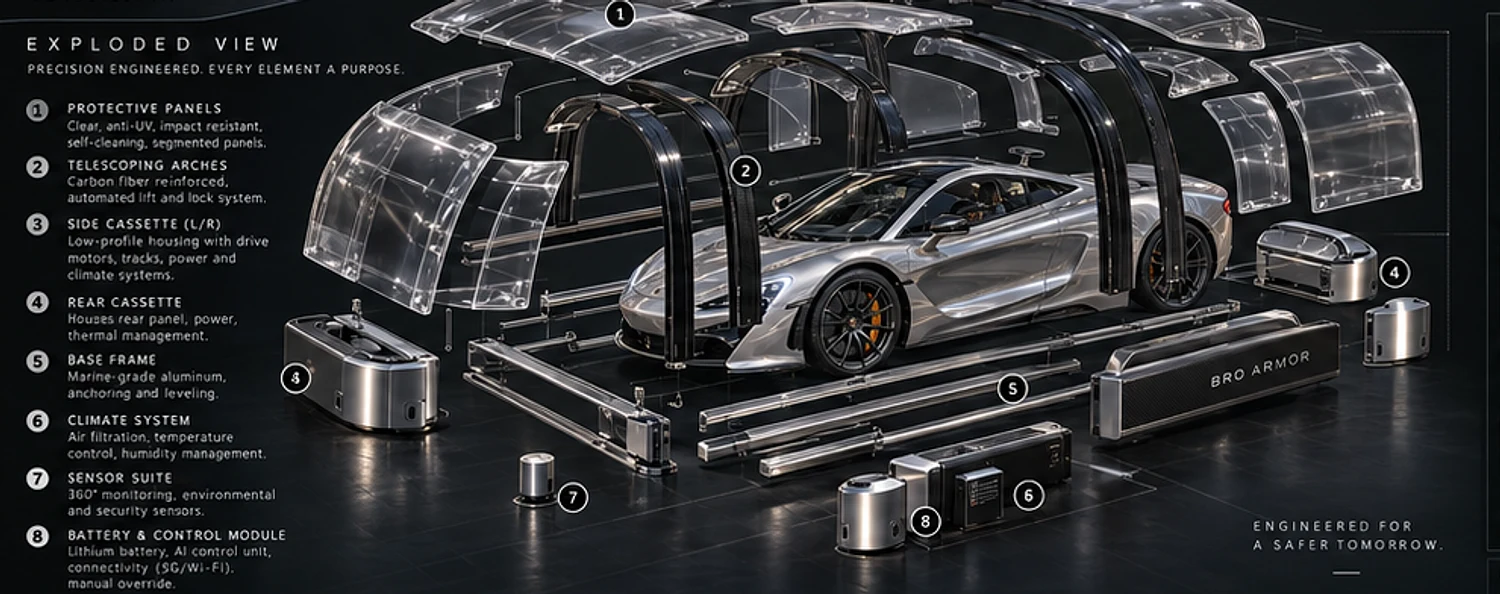
Protective panels
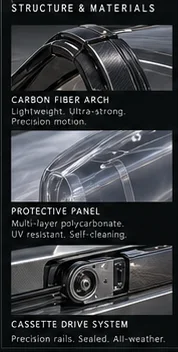
Narrow nested segments of hard-coated, UV-stabilised polycarbonate with overlapping shingled edges. Individually replaceable.
Telescoping arches
Four primary and two secondary arches. Carbon-composite outer sections over aluminium internal wear surfaces.
Side cassettes (L/R)
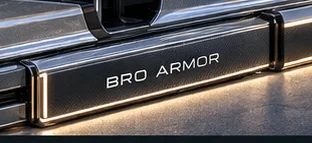
Drive motors, panel storage, climate plenum, power, PV top face and the lateral translation mechanism.
Rear cassette
Rear panel storage, thermal management, PV top face and the rear receiver rail.
Perimeter rail
Lower seal, gutter and drain path, plus the locking receivers.
Climate system
Filtered intake, variable-speed blowers, high exhaust, temperature and humidity sensing.
Sensor suite
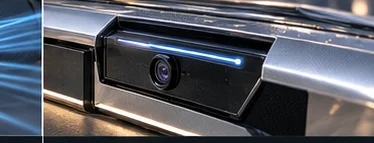
60 GHz mmWave perimeter nodes, cameras, accelerometers, tamper loop, lock position sensing.
Battery and control
Dedicated 48 V LiFePO₄ pack, MPPT, motor controllers, the ECU, connectivity and manual override.
The part that makes it manufacturable
Narrow nested segments, not one curved sheet.
A single curved polycarbonate canopy would look right in a render and would never package into a rocker panel. It cannot nest, it cannot tolerate a changing radius, and one scratch writes off the whole surface.
So the transparent shell is built from 100–180 mm segments with overlapping shingled edges. They stack tightly inside the cassettes, tolerate the curvature of the arch, and any one of them can be replaced on its own.
Indicative thickness is 3–4.5 mm across the roof and 4.5–6 mm on the lower, more exposed sides. Final thickness comes from impact, wind and hail testing, not from a preference.
The hard part
The shell rolls. That is the whole trick.
The narrow segments above stay exactly as described — what changes is how they are stored. A full enclosure needs about twenty-five square metres of transparent surface. Held as rigid panels that nest and slide, it weighs 239 kg and needs three times the volume the modules have. Hinged into a curtain that rolls, it weighs 150 kg and fits in six drums the width of your wrist.
| <b>Architecture</b> | Mass · Stows? |
|---|---|
| Sliding nested panels, full enclosure | 239 kg · 3.3× over volume |
| Canopy to window line | 132 kg · fits, but not a full enclosure |
| Rolling curtain, full enclosure | 150 kg · fits, and encloses everything |
What rolling costs: a visible joint line every 90 mm, a seal at every one of those joints, and separate closures for the nose and tail. None of that is free, and all of it is ordinary sectional-door engineering rather than a research problem.
Sliding panels were the wrong way to store sheet
Nested flat segments waste most of their volume in air gaps and guides. Rolling is the most space-efficient way to store a continuous surface that exists — it turns area into a cylinder.
Six drums, 93 mm across
Three per side, living in the three modules the architecture already has: front receiver, rocker, rear cassette. Each drum is 1.88 m long and disappears inside a 140 mm housing.
Slats run fore-and-aft
That makes the curtain stiff along the car and flexible across it — which is exactly what lets it wrap a transverse arch and still coil onto a drum whose axis runs along the sill.
The curtain carries itself
A curved slat resists load in hoop, not in bending. So the arches stop being primary structure and become guide rails, and the structure budget falls from 22 kg to 9 kg.
The shell follows the car
A constant-section tunnel encloses a lot of empty air above a low nose and tail — 19% more surface than the vehicle needs. Following the profile removes that area, and with it the mass, the cost and the bulk.
It is not a new invention
Transparent polycarbonate roller shutters are an established shopfront product. The novelty here is putting one on a vehicle, curved over an arch, sealed, and driven automatically.
Safety
A machine that moves around a $500,000 car.
Every one of these is an interlock, not a feature.
Will not deploy unless the vehicle is stationary and in Park.
The vehicle cannot be driven with the enclosure deployed.
The ground is scanned before anything moves, and watched while it does.
Motor current sensing catches an obstruction the optical sensors miss.
On any anomaly: immediate stop, then 50–100 mm of reverse travel.
Pinch-force limiting on every closing edge.
Manual release and manual retraction, with no power at all.
Wind-speed and incline inhibits.
A ring-fenced charge that guarantees one full retraction.
Hardware
Where it lives on the car.