Climate
Air has to move, or the shell becomes an oven.
This is the part of a transparent enclosure that goes wrong first. It gets a dedicated subsystem rather than a vent.
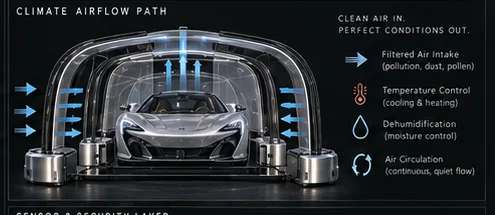
A sealed clear enclosure in direct sun builds heat with nothing to carry it away, and a sealed enclosure at night builds condensation. Both damage a car that was supposedly being protected.
BRO ARMOR runs continuous filtered ventilation through the clearance gap, with fan speed set by sensors rather than a timer, and it escalates before it becomes a problem.
How it behaves
Filtered intake, low in the rails
Air enters through replaceable filters at the lowest point of the side cassettes, where it is coolest and cleanest.
The gap is the duct
That 150–250 mm of clearance is not empty space. It is the channel the air travels along the whole length of the car.
Exhaust at the crown
Warm air leaves through protected vents at the top, which is where it was trying to go anyway.
Sensors set the pace
Roof, front, rear and ambient temperature plus humidity decide fan speed, continuously, all day.
Dry matters more than cool
The system targets a dewpoint margin rather than a number on a dial. Condensation is what damages a car overnight.
It escalates before you would
Over threshold: fans up, vents open, you are told — and if the limits are passed, it retracts itself.
Winter
Hydrophobic coating, −40 °C seals, heated drain channels, snow-load monitoring, and a de-ice check before the panels are allowed to move.
The objection
The obvious objection is that it becomes an oven.
It would, if it were sealed. It is not. It is a shaded, ventilated cavity, and those are different physics. Here is the worst case we could find: Miami, July, noon, 1,000 W per square metre, 35 °C in the shade.
| Solar the car absorbs, uncovered | 9,120 W |
|---|---|
| Solar the car absorbs, enclosed | 3,876 W |
| Reduction from shading alone | 57% |
| Heat left in the cavity | 2,405 W |
| Airflow to carry it away at +8 K | 546 CFM — 72% of the fan array |
| Power that costs | 43 W |
| Over a ten-hour day | 431 Wh, against ~927 Wh generated |
| Uncovered in the sun | ≈ 65 °C cabin |
|---|---|
| Inside a ventilated enclosure | ≈ 46 °C cabin |
The enclosure does not fight the sun. It stands between the sun and the car, and then spends forty-three watts moving air. On the hottest, brightest day — the day the objection says it cannot work — it is also the day the roof generates the most power.
Warmth
Cold is a different problem, and it has a different answer.
Cooling is ventilation, and ventilation is nearly free. Heating is heat loss through twenty-five square metres of glazing, and that is expensive. So warmth is split into what a battery can honestly do and what a plug can.
On battery
A pre-departure warm-up: yes
Raising the enclosure 20 K before you leave costs about 338 Wh including the surfaces and the car itself. That fits inside the pack with the retraction reserve untouched. Schedule it from the app and walk out to a car that is not frozen.
Holding warmth all night: no
Even with a twin-wall shell, holding +20 K costs 1,467 W continuously. The pack would last thirty-nine minutes. We are not going to pretend otherwise.
Keeping ice off: cheap
Heated drain channels, a hydrophobic coating and a de-ice check before the panels move. Tens of watts, not thousands.
Plugged in
At home it becomes a heated garage
On an ordinary domestic outlet with a twin-wall shell and a reversible heat pump, the system holds a temperature difference far beyond anything a Canadian winter asks of it. Energy stops being the constraint the moment there is a cable.
Which is arguably the bigger market
A climate-controlled, secure, dehumidified space for a car — for people with a driveway and no garage. No foundations, no planning application, and it moves house with you.
Twin-wall glazing is the enabler
A sealed cavity between two thin skins roughly halves the heat loss, and per unit of stiffness it is lighter than solid sheet. It is the same decision that makes the rolling shell work.
The standard pack is 1.2 kWh. A 3 kWh option adds roughly $380 and 20 kg and buys seven warm-ups and nearly nine days of darkness — worth it for a cold climate, unnecessary for a warm one.
Honest limits
This is ventilation and rejection, not refrigeration.
Standard BRO Climate manages the enclosure with solar and UV rejection, a shaded ventilated air gap, variable-speed filtered airflow and humidity control. That is enough to stop the greenhouse effect and to keep the enclosed air near ambient.
It is not an air conditioner, and it will not hold 21 °C inside while it is 45 °C outside. True refrigeration for a volume this size costs battery, weight, packaging and money — so it belongs on the options list, not in the base system.
Published research on radiative-cooling vehicle covers shows large reductions in parked cabin temperature versus an uncovered car. Those are other people's test conditions, not a BRO ARMOR performance figure, and we will publish ours when we have measured them.